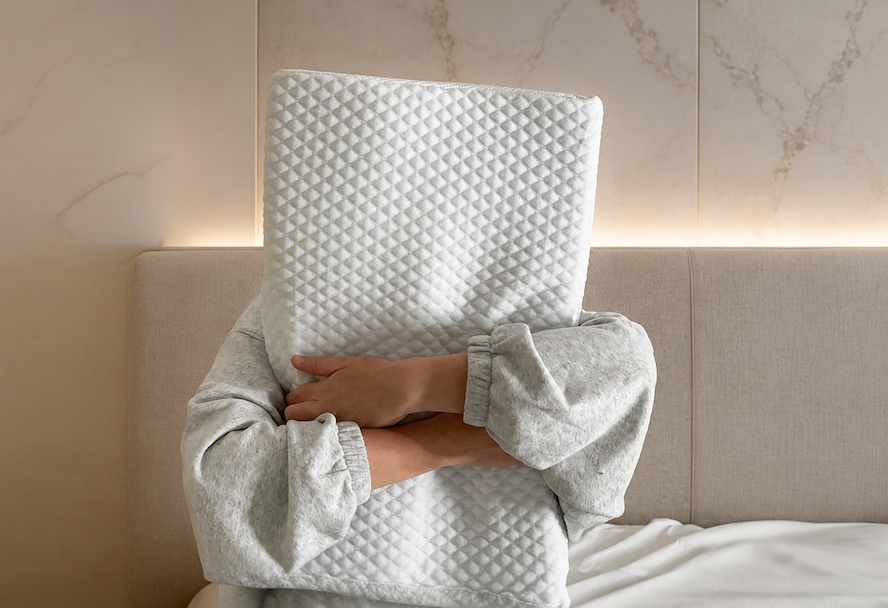
If you're a side sleeper, you've probably spent a lot of time thinking about whether your pillow should be soft, firm, memory foam, feather or something else entirely. And with 50% of the nation sleeping on their side, that's a lot of you that have been thinking about this!

But one of the most important things to think about when it comes to a restful night's sleep is simple, you need to ask yourself 'how high is your pillow?'
To answer that question, we decided to go deep. We combed through 26 peer-reviewed studies and clinical trials alongside 12 population and consumer surveys from the UK and around the world. The research looked at everything from pillow height and shoulder dimensions to sleeping position, comfort, neck symptoms and mattress firmness.
The main takeaway from our research shows that the ideal pillow is around 7–11cm for side sleepers, but your body, shoulders and mattress all make a difference.
Best Pillow For Side Sleepers
When you sleep on your side, your shoulder creates a gap between your mattress and your head and neck. Your pillow needs to comfortably fill that space.
That means someone with broader shoulders may need a higher pillow, while someone with a smaller frame may need less height. So, effectively, there isn't one pillow height that's going to be perfect for every side sleeper.
When you're looking for the best pillow for side sleeping, the height should be a big part of the decision making process.
How High Should A Pillow Be For Side Sleepers?
It turns out that there isn't one perfect pillow height for every side sleeper, but instead a range. Several studies have looked specifically at how pillow height affects neck position, muscle activity and comfort.
Sacco and Lorenzetti et al. (2015) tested three pillow heights, 5cm, 10cm and 14cm, in 21 participants lying on their side. Of the three, the 10cm pillow produced the lowest neck-muscle activity and the highest comfort rating, while the 5cm pillow performed worst.
A 2024 pilot study published in Sleep and Breathing took a more individual approach. Researchers tested pillow heights at 0.5, 1 and 1.5 times each participant's side-lying shoulder height. The pillow closest to the person's own side-lying shoulder height produced the lowest muscle activity and was rated the most comfortable.

Another 2024 study published in Medical & Biological Engineering & Computing tested heights between 8cm and 14cm and used motion capture and musculoskeletal modelling to look at cervical positioning. In this small study of nine participants, an individualised medium height of approximately 9.7–11.8cm produced the most natural cervical curve.
There's also broader evidence behind the range. A 2021 systematic review by Radwan et al. found moderate evidence supporting pillow heights of around 7–11cm, alongside factors such as pillow shape and material. Earlier studies by Ren et al. (2016) and Son et al. (2015) also found that changing pillow height measurably changes cervical angle and contact pressure.
Taken together, the research points towards roughly 7-11cm as a useful starting range for side sleepers, but importantly, not as a universal prescription.
The more recent research suggests that individual body dimensions, particularly shoulder measurements, should help determine the right pillow height for each person. This isn't surprising since we're individual so it makes sense that our perfect pillow should be as unique as we are.
Does Pillow Height Affect Side Sleepers?
When you sleep on your side, your shoulder creates a gap between your head and the mattress, which your pillow needs to fill.
Ren et al. (2016) found that changing pillow height altered cervical spine alignment, while Son et al. (2015) found that pillow height affected the pressure placed on the head and neck.
This supports the idea that pillow height matters for side sleepers, and that the same height won't necessarily suit every body.
Mattresses Matter As Well
Your pillow isn't the only part of your sleeping setup that can affect your position.
How far your body sinks into the mattress may change the relationship between your shoulders, head and pillow, so pillow height shouldn't necessarily be considered in isolation.
However, there isn't currently strong research showing exactly how much side sleepers should adjust their pillow height based on mattress firmness. For now, it's another reason to consider your overall sleeping setup rather than relying on one fixed pillow height for every side sleeper.

How To Find Best Pillow For You
Across the studies we reviewed, pillow height was one of the clearest evidence-backed factors for side sleepers.
Sacco and Lorenzetti et al. (2015) found 10cm performed best of the 5cm, 10cm and 14cm heights tested, while Jiao et al. (2024) found better results when pillow height was matched to individual shoulder height. Radwan et al. (2021) found moderate evidence supporting a broader 7–11cm range.
So we'd look at pillow height, shoulder dimensions, mattress firmness and adjustability, rather than choosing something simply because it's labelled a side-sleeper pillow.
Final Takeaway
What it comes down is simple, there isn't one universally best pillow for side sleepers, we're all unique, so our pilows should be too!
However, the evidence we reviewed points towards roughly 7-11cm as a useful starting range for pillow height dpending on your body dimensions, Jiao et al. (2024) and Tian et al. (2024).
For side sleepers, this makes being able to fine-tune pillow height usefu like in the Groove Adjustable Pillow, which has five height and depth combination, rather than relying on one fixed height designed to suit everyone.

Research & Sources
For our 2026 Side Sleeper Research, Groove Pillows reviewed 38 sources, including 26 peer-reviewed studies, clinical trials and systematic reviews, alongside 12 population and consumer surveys covering the UK and international populations.
The key research referenced in this article includes:
YouGov (2022) – The YouGov Sleep Study: Part Two – Sleep Habits
A nationally representative survey of British adults examining sleeping habits and preferred sleeping positions. The research found that 50% of British adults usually sleep on their side, with 27% sleeping on their right side and 23% on their left.
Sacco, I.C.N., Pereira, I.L.R., Dinato, R.C., Silva, V.C.B., Friso, B. and Viterbo, S.F. (2015) – The effect of pillow height on muscle activity of the neck and mid-upper back and patient perception of comfort
Published in the Journal of Manipulative and Physiological Therapeutics. This laboratory study of 21 participants compared 5cm, 10cm and 14cm pillow heights during side lying. The 10cm height produced the lowest neck muscle activity and highest comfort rating of the three heights tested.
Jiao et al. (2024) – Pillow height and neck muscle activity during side lying
Published in Sleep and Breathing. This pilot study of 15 participants tested pillow heights at 0.5, 1 and 1.5 times each individual's side-lying shoulder height. The height corresponding to the individual's shoulder height produced the lowest muscle activity and greatest reported comfort.
Tian et al. (2024) – Individualised optimal pillow height for side sleepers
Published in Medical & Biological Engineering & Computing. This study used motion capture and musculoskeletal modelling to investigate pillow height and cervical positioning. In the small sample of nine participants, individualised medium pillow heights of approximately 9.7–11.8cm produced the most natural cervical curve.
Radwan et al. (2021) – Effect of different pillow designs on promoting sleep comfort, quality and spinal alignment: a systematic review
This systematic review assessed the available evidence around pillow design, height, material, comfort and cervical symptoms. It found moderate evidence supporting factors including pillow heights of approximately 7–11cm, contoured designs and latex materials for some cervical outcomes.
Ren et al. (2016) – Effect of pillow height on the biomechanics of the head-neck complex: investigation of the cranio-cervical pressure and cervical spine alignment
This biomechanical study examined how different pillow heights affect cervical spine alignment during side lying, supporting the finding that changing pillow height changes cervical positioning.
Kim et al. (2015) – The Effect of Different Pillow Heights on the Parameters of Cervicothoracic Spine Segments
This study of 16 asymptomatic adults compared pillow heights of 0cm, 10cm and 20cm while participants lay on their backs. Researchers found that changing pillow height altered several measures of cervical spine alignment. Of the three heights tested, the authors considered 10cm the most suitable for maintaining normal cervical lordosis.