Medically reviewed by Dr Divyansh Jain, MD, MSc
Feeling achy or stiff in the mornings? Menopause neck pain isn’t in your head and you’re not alone at all.
More than 70% of women experience musculoskeletal symptoms during menopause (Wright et al., 2024), due to changes in hormone levels, particularly oestrogen. This makes muscles, joints, and other connective tissues more susceptible to tension and pain.
Not only that, but neck pain often feels worse at night or first thing in the morning, disrupting all-important sleep and daily life.
Here’s a quick guide to neck pain and menopause — and what you can do to get relief!
Can Menopause Cause Neck Pain?
Neck pain can occur during perimenopause and menopause, and hormonal or sleep changes may contribute in some people. However, menopause shouldn't automatically be assumed to be the cause of neck pain.
Changes in oestrogen may affect several musculoskeletal tissues and pain perception, but their contribution to an individual's neck pain cannot be assumed.
Other factors that may contribute include:
- Sleep disturbance and stress — Poor sleep, night sweats and stress may increase fatigue and pain sensitivity, making existing discomfort feel more noticeable.
- Musculoskeletal changes — Changes in oestrogen may affect collagen and connective-tissue biology, although the clinical importance for neck strain remains uncertain.
- Age-related changes — Conditions such as cervical spondylosis become more common with age and can cause neck or shoulder pain and stiffness.
- Posture and physical loading — Prolonged desk work, phone use, occupational positions and changes in activity can all contribute to neck discomfort.
- Sleep quality — Night sweats and disrupted sleep may make existing aches and stiffness more noticeable. You can also read our guide on how to sleep better during the menopause.
Headaches, shoulder tension and upper-back pain can also occur during menopause, but they aren't necessarily caused by hormonal changes and may require separate assessment.
How To Get Rid Of Menopause Neck Pain (Step-by-Step)
1. Find a Comfortable Pillow Height
Appropriate pillow height varies between individuals and depends on your sleeping position, body dimensions, mattress firmness and personal comfort rather than sex alone.
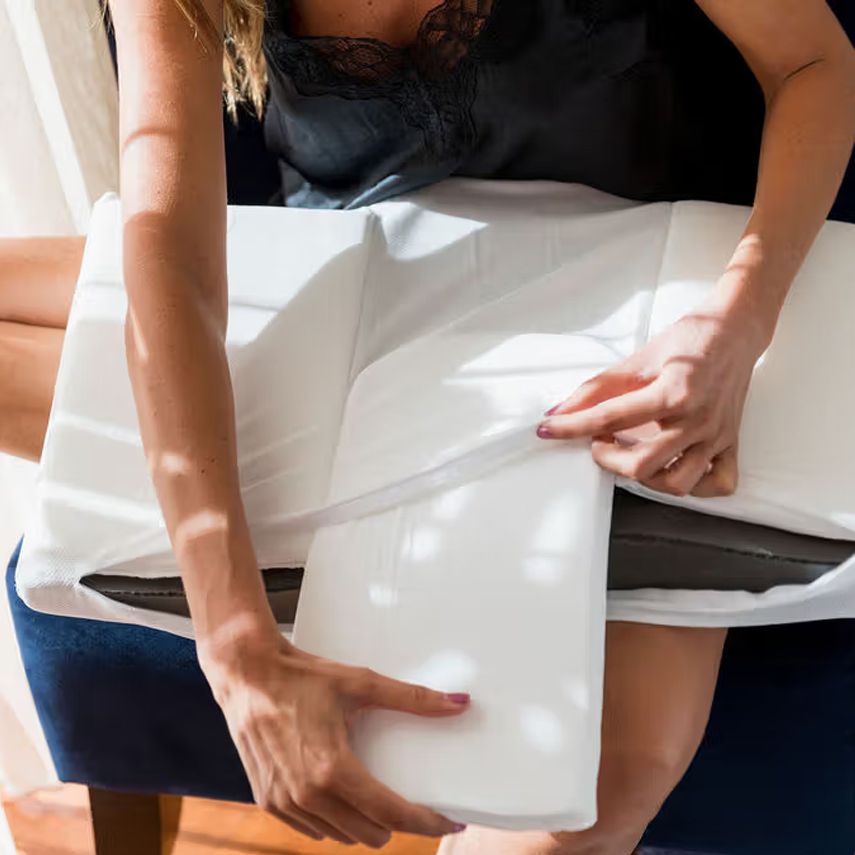
The Groove Adjustable Pillow contains multiple layers that allow you to alter the pillow's height.
This can make it easier to experiment with different heights until you find one that feels comfortable for your head and neck. Whether an adjustable pillow reduces pain or strain varies between individuals and hasn't been established specifically for this product.
Research into pillows for chronic neck pain is also limited, with no pillow type or material clearly established as superior. Pillow adjustment is therefore better considered an optional comfort measure rather than a treatment for neck pain.
2. Support The Cervical Curve
Rather than trying to maintain a perfect cervical curve, choose a sleeping position that feels comfortable and doesn't hold your neck in marked flexion, extension or rotation.
A suitable pillow shouldn't force your neck into an uncomfortable sustained angle.
The right height may improve morning comfort for some people, but a pillow can't be guaranteed to prevent stiffness or treat the underlying cause of neck pain.
3. Maintain Side-Sleeping Alignment
Side-sleeping can be perfectly comfortable when the head and neck are adequately supported.
When sleeping on your side, pillow height should comfortably fill the space between your head and mattress without forcing your neck noticeably sideways.
Some people find an ergonomic memory foam pillow or adjustable pillow comfortable, but no particular pillow material has demonstrated clear superiority for chronic neck pain.
If you're also experiencing menopause hip pain, your overall sleep setup may need adjusting to avoid uncomfortable pressure around both the neck and hips.
4. Improve Your Back-Sleeping Position
Back-sleeping may be comfortable for some people when the pillow doesn't push the head excessively forwards.
When lying on your back, avoid a pillow that noticeably forces your chin towards your chest or allows your head to tip far backwards.
Back sleeping isn't automatically the best position for neck pain, however, and it may not suit everyone. An appropriate pillow may improve comfort but isn't a treatment for the underlying cause of neck pain.
5. Avoid Stomach Sleeping
Stomach sleeping requires sustained neck rotation and may aggravate symptoms in some people, irrespective of menopause.
If you regularly wake with increased stiffness after sleeping on your stomach, experimenting with a different position may be worthwhile.
For more information, view Groove’s selection of supportive pillows.
Lifestyle Tips To Reduce Menopause Neck Pain
Pillow adjustment is one optional comfort measure. Remaining active and identifying the underlying cause of persistent neck pain are generally more important.
Depending on your symptoms, you could try:
- Gentle mobility exercises for the neck and upper back.
- Appropriate strengthening exercises to improve strength and function.
- Avoiding long periods in positions that noticeably aggravate your neck.
- Maintaining normal hydration for general health.
- Following a balanced diet with adequate protein, calcium and vitamin D.
- Improving sleep hygiene.
- Managing stress with approaches such as relaxation exercises or yoga.
- Using heat or cold for temporary symptom relief.
- Trying a cooling pillow if night sweats or hot flushes are affecting sleep comfort.
Cooling pillows may improve temperature comfort for some people experiencing hot flushes or night sweats, but they haven't been shown to treat musculoskeletal pain or the hormonal processes involved in menopause.
Appropriate activity can help improve strength, mobility and function. However, stop exercising and seek advice if movements cause radiating pain, weakness, numbness or worsening symptoms.
Studies looking at pain during menopause also suggest that there isn't one approach that works for everyone (Strand et al., 2024). Try low-risk comfort measures one at a time, but seek professional assessment if symptoms are persistent, progressive or severe.
If hot flushes, night sweats, sleep disturbance or other menopause symptoms are significantly affecting your quality of life, speak to a GP or suitably qualified healthcare professional with recognised menopause training about evidence-based treatment options. HRT may be appropriate for some menopause symptoms but shouldn't be viewed as a proven treatment for isolated neck pain.
The Role Of Mattresses & Sleep Environment
A mattress that sags or feels uncomfortable may affect your sleep and symptoms, but replacing your mattress isn't an evidence-based treatment for menopause-associated neck pain.
There also isn't a particular mattress firmness established as best for menopause-related or cervical pain.
Instead, focus on individual comfort and whether your mattress and pillow combination allows you to sleep without consistently aggravating your symptoms.
You can also experiment with an adjustable pillow to find a height that suits your preferred sleep position and mattress.
When To Seek Professional Help
Arrange an assessment with a GP, physiotherapist or other qualified healthcare professional if neck pain lasts more than a few weeks, repeatedly returns, progressively worsens, significantly affects sleep or daily activities, or doesn't respond to reasonable self-care.
Seek urgent medical attention if you develop:
- New or worsening arm or leg weakness, numbness or persistent tingling
- Clumsy hands, dropping objects, difficulty walking or poor balance
- New bladder or bowel problems
- Severe pain following a fall, collision or other significant injury
- Fever, marked neck stiffness, confusion, rash or severe illness
- Unexplained weight loss, a history of cancer or severe unrelenting night pain
- Sudden severe headache, fainting, double vision, slurred speech or difficulty swallowing
- Chest pressure, breathlessness, sweating or pain spreading into the jaw, neck, back or arm
In adults over 50, a new headache or scalp tenderness alongside jaw pain when chewing or visual symptoms needs urgent same-day medical assessment. New and pronounced shoulder and neck stiffness, particularly if it lasts for more than around 45 minutes in the morning, should also be discussed promptly with a clinician.
Most uncomplicated neck pain improves with conservative care, but neurological or other concerning symptoms shouldn't be managed solely by changing your pillow.
Final Words
Neck pain can occur during perimenopause and menopause, and hormonal changes, disrupted sleep and changes in pain sensitivity may contribute for some people. However, neck pain during this stage of life isn't always caused by menopause.
Pillow and sleep-position adjustments may improve comfort for some people, but evidence is limited and they shouldn't replace appropriate clinical care.
If your current pillow feels uncomfortable, the Groove Adjustable Pillow allows you to alter its height to find a setup that better suits your sleep position and body dimensions. Stop using or adjust any pillow that consistently worsens pain, headaches, arm symptoms or sleep.
Start today with the Groove Adjustable Pillow.
References
- NICE. Menopause: identification and management (NG23). NICE Menopause Guidance
- NHS. Neck pain and stiff neck. NHS Neck Pain Guidance
- NHS. Cervical spondylosis. NHS Cervical Spondylosis Guidance
- Ghosh, Goyal and Goyal (2025). Systematic review of pillow interventions for chronic neck pain. PubMed
- Strand, N.H., D'Souza, R.S., Gomez, D.A., Whitney, M.A., Attanti, S., Anderson, M.A., Moeschler, S.M., Chadwick, A.L. and Maloney, J.A. (2024). Pain during menopause. Maturitas, 191, 108135. https://doi.org/10.1016/j.maturitas.2024.108135
- Wright, V.J., Schwartzman, J.D., Itinoche, R. and Wittstein, J. (2024). The musculoskeletal syndrome of menopause. Climacteric: The Journal of the International Menopause Society, 27(5), pp.1–7. https://doi.org/10.1080/13697137.2024.2380363