Medically reviewed by Dr Divyansh Jain, MD, MSc
If you're suffering from cervical spondylosis, getting a good night's sleep might feel impossible.
Neck pain that persists throughout the night is nothing short of exasperating.
But luckily, there are solutions out there.
How Cervical Spondylosis Affects Sleep
Since symptoms of cervical spondylosis include neck stiffness and pain, it can be challenging to find a comfortable sleeping position.
Not being able to sleep with cervical spondylosis can start an unfortunate cycle.
Sleep is critical to healing. Damaged tissues heal at a faster rate during sleep, and adrenaline released through wakeful stress prevents cell division needed for healing (Adam and Oswald, 1984).
So, without good sleep, the body can’t soothe the condition.

The Best Pillow For Cervical Spondylosis
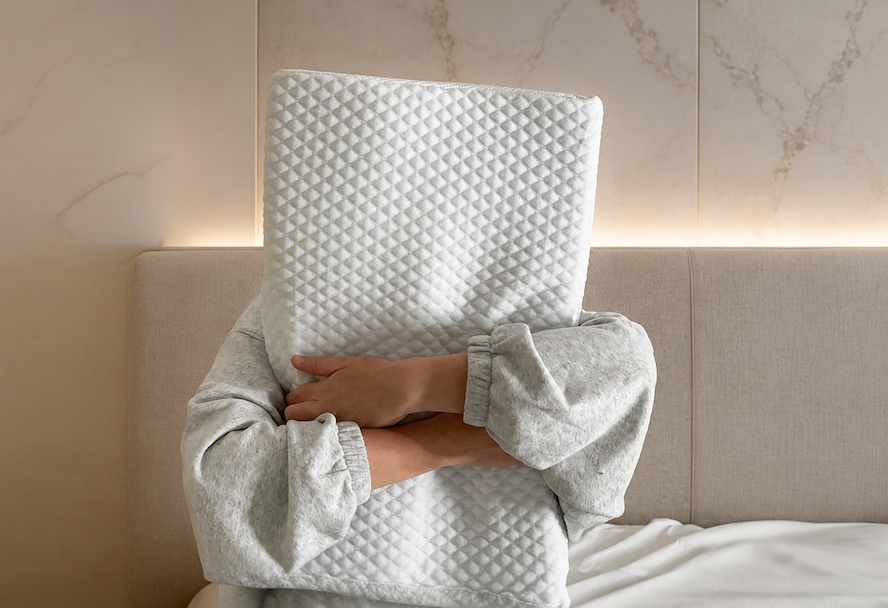
Sleeping positions for cervical spondylosis often come back to how comfortably your neck is supported. There is no clinically established “best” pillow for cervical spondylosis, but some people find a contoured pillow like the Groove Original Pillow comfortable because its shape is designed to support the head and neck.
When looking for a memory foam pillow for cervical spondylosis, some people find contoured or “cervical” pillows comfortable. These commonly have a central area for the head and a raised contour intended to support the neck.
The aim is to find a pillow height and firmness that feels comfortable without forcing your neck into a painful angle.
It is also made from memory foam which has viscoelastic properties. This means the foam changes shape in response to pressure and heat and moulds around the head and neck. However, memory foam has not been shown to be clinically superior to other pillow materials for cervical spondylosis.
How To Sleep With Cervical Spondylosis
Finding a comfortable way to sleep with cervical spondylosis may take some trial and adjustment. A supportive pillow, comfortable sleeping position and good bedtime routine may all help.
Sleeping Positions For Cervical Spondylosis
Back or side sleeping may be more comfortable for some people with cervical spondylosis, although there is no single sleeping position that is best for everyone.
Your main goal should be to avoid positions that hold your neck in marked or painful rotation, flexion or extension for long periods. A comfortable, approximately neutral position may help reduce positional discomfort.
If on your back, use a pillow that supports your neck without forcing your head markedly forwards or backwards.
If on your side, try to keep your face approximately forward and in line with your chest. Your pillow should fill the space between your head and the mattress without noticeably tilting your head upwards or downwards. A specialised knee pillow can help keep your spine and hips in a neutral position on your side.

Pre-Bedtime Routines For Cervical Spondylosis
Pre-bedtime routines can help you alleviate your symptoms before bed, resulting in a more restful night.
Exercise can form part of the management of cervical spondylosis, but the right exercises will depend on your individual symptoms. A physiotherapist may recommend cervical mobility, motor-control or shoulder-blade strengthening exercises after assessing you.
Exercises should be individualised, particularly if you have pain travelling into an arm, numbness, weakness, problems with balance or a history of cervical surgery. If an exercise causes radiating pain, dizziness, numbness or weakness, stop and seek professional advice.
Another way to prepare your neck before sleep is via heat therapy. Gentle heat may provide temporary relief from muscular pain or stiffness for some people, although it does not treat the degenerative changes associated with cervical spondylosis.
If using a hot water bottle or heat pack, wrap it in a towel and use gentle warmth for around 10–20 minutes. Never apply it directly to the skin or fall asleep with it in place.
The Bottom Line
If your neck pain persists for several weeks, repeatedly returns, significantly affects your sleep or daily activities, or is accompanied by persistent pain, tingling or numbness extending into an arm, contact a doctor or physiotherapist for professional advice.
Seek urgent medical advice for new or worsening weakness, persistent or worsening numbness or tingling, severe or rapidly worsening neck pain, significant pain following an injury, or new problems with balance, walking or hand coordination. Seek emergency care for new loss of bladder or bowel control or rapidly progressive weakness or numbness.
Learn more about the Groove Pillow online today. Or jump to our blog for more expert advice.
References
- NHS. Cervical spondylosis. Available at: https://www.nhs.uk/conditions/cervical-spondylosis/
- NHS. Neck pain and stiff neck. Available at: https://www.nhs.uk/symptoms/neck-pain-and-stiff-neck/
- Mayo Clinic. Cervical spondylosis – Symptoms and causes. Available at: https://www.mayoclinic.org/diseases-conditions/cervical-spondylosis/symptoms-causes/syc-20370787
- Ghosh, Goyal and Goyal (2025). Systematic review of pillows for chronic neck pain. Available at: https://pubmed.ncbi.nlm.nih.gov/40633255/