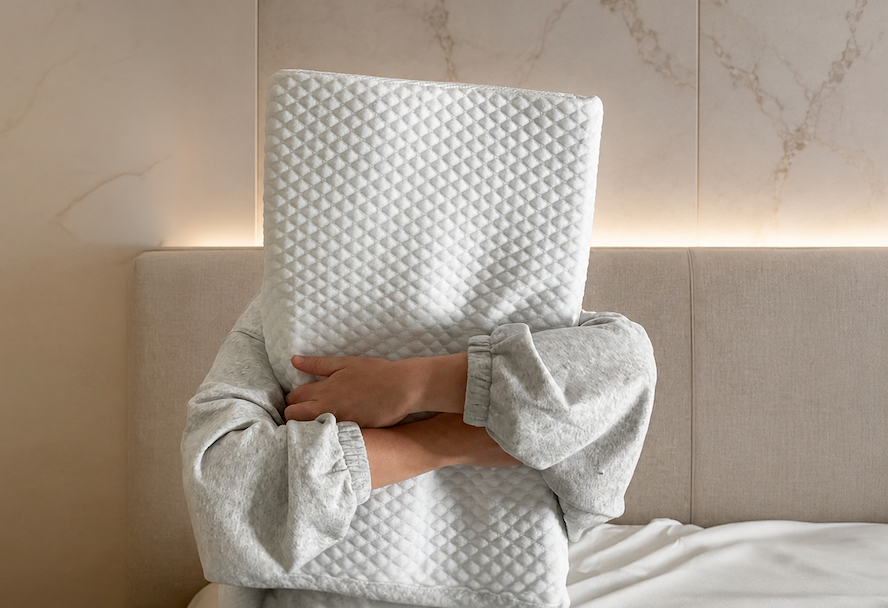
Ever woken up to find a wet patch on your pillow?
Occasional drooling is common, particularly if you sleep on your side or front, or breathe through your mouth at night.
Here’s what to know if you’ve noticed drool when waking up.
Common Causes of Drooling in Your Sleep
Drooling in your sleep happens when saliva escapes your mouth while you're resting.
Your body keeps producing saliva overnight, even though production generally slows. A 2003 research paper explains that saliva production drops considerably during sleep, while the saliva that remains helps protect and lubricate your mouth (Thie et al., 2002).
Your sleeping position can make a difference. When you lie on your side or stomach, gravity makes it easier for saliva to escape onto your pillow.
A blocked nose from a cold or hay fever can also encourage mouth breathing, making drooling more noticeable. A medical review explains that nasal obstruction can encourage mouth breathing during sleep, particularly when airflow through the nose is restricted (Scharf and Cohen, 1998).
Other possible causes include:
- Acid reflux
- Certain medications
- Difficulties with swallowing
Occasional drooling doesn't necessarily mean something is wrong, but it is helpful to know why it’s happening.

How Can You Reduce Drooling in Your Sleep?
Wondering how to stop drooling in your sleep? The best approach depends on what's causing it.
Here are a few things worth trying:
- Address nasal congestion: If you have a blocked nose, ask your pharmacist about suitable treatments for colds or allergies.
- Try a different sleeping position: If you're comfortable sleeping on your back, gravity may help keep saliva inside your mouth.
- Review your medication: If drooling started after taking a new medicine, speak to your GP or pharmacist. Don't stop taking prescribed medication without medical advice.
However, back sleeping can worsen breathing problems for some people with obstructive sleep apnoea. If you suspect or have been diagnosed with sleep apnoea, seek medical advice before changing your sleeping position to manage drooling.
You can also explore our guide on how to sleep on your back for practical positioning tips.
Remember, you don't need to force yourself into an uncomfortable sleeping position just to avoid a damp pillow!
When Should You Speak to Your GP About Drooling at Night?
You might be wondering, is it normal to drool in your sleep?
In most cases, occasional drooling is nothing to worry about. However, persistent or unusual changes deserve attention.
If you're asking why am I suddenly drooling in my sleep, particularly when it wasn't previously an issue, consider speaking to your GP.
You should also seek medical advice if you:
- Experience drooling regularly during the day
- Have difficulty swallowing
- Notice drooling becoming increasingly excessive
- Experience persistent daytime tiredness
- Wake up gasping or choking, or someone notices pauses in your breathing during sleep
The last two symptoms, in addition to snoring, may indicate obstructive sleep apnoea, which requires proper assessment. You can read more in the NHS guide to sleep apnoea.
If drooling begins suddenly alongside facial weakness, difficulty speaking or other possible stroke symptoms, call 999 immediately.

Final Thoughts
If you already sleep on your back, or feel comfortable trying it, finding the right pillow height can make your setup more comfortable.
The Groove Adjustable Pillow features four adjustable memory foam layers, allowing you to experiment with different heights to support your head and neck.
While a pillow won't treat the underlying causes of drooling, comfortable support can help you settle into your preferred sleeping position.
Ultimately, a little drooling is usually nothing to lose sleep over. Focus on your comfort, and speak to your GP if you notice anything unusual.
References
- NHS (2022). Sleep apnoea. [online] NHS. Available at: https://www.nhs.uk/conditions/sleep-apnoea/.
- Scharf, M.B. and Cohen, A.P. (1998). Diagnostic and treatment implications of nasal obstruction in snoring and obstructive sleep apnea. Annals of allergy, asthma & immunology : official publication of the American College of Allergy, Asthma, & Immunology, [online] 81(4), pp.279–87; quiz 287–90. doi:10.1016/S1081-1206(10)63120-1.
- Thie, N.M.R., Kato, T., Bader, G., Montplaisir, J.Y. and Lavigne, G.J. (2002). The significance of saliva during sleep and the relevance of oromotor movements. Sleep Medicine Reviews, 6(3), pp.213–227. doi:10.1053/smrv.2001.0183.