Written by Myrlène Fortin
Medically reviewed by Dr Divyansh Jain, MD, MSc

Waking up with aches instantly puts you in a bad mood. But these pesky pains are even more impossible to ignore when in your jaw area.
Ready to release the pain?
This blog covers everything you need to know about TMJ causes including possibly your pillow, pillows to help TMJ, and how to rid yourself of this annoying ache.
Let’s dive in.
What Is TMJ Pain?
The temporomandibular joints (TMJs) connect your lower jaw to your skull and are involved whenever you talk, chew or open your mouth.
The conditions affecting these joints and the surrounding muscles are more accurately called temporomandibular disorders (TMDs) rather than simply "TMJ".
TMD is an umbrella term covering more than 30 conditions affecting the jaw joints, chewing muscles and associated structures (NIDCR).
Common symptoms can include:
- Jaw or facial pain
- Pain while chewing
- Reduced jaw opening
- Painful clicking or grinding
- Jaw locking
- Pain around the ear or temple
Painless clicking is relatively common and doesn't necessarily require treatment.
TMD is also multifactorial. Possible contributors can include trauma, arthritis, clenching or grinding, musculoskeletal factors and pain sensitisation. Jaw discomfort may feel worse after sleep in some people, but it usually can't be attributed to your pillow alone.
Can Sleep Position Cause TMJ?
Sleep position may influence morning jaw or neck discomfort in some people, but research hasn't established one position as a cause of, or treatment for, TMD.
Sleeping with the painful side of your face pressed firmly into the pillow may aggravate symptoms for some people. Similarly, stomach sleeping requires prolonged head rotation, which may worsen neck or jaw discomfort.
Some people find back sleeping more comfortable because it avoids direct pressure on the side of the jaw. However, back sleeping isn't universally the "best" position for TMD and isn't suitable for everyone.
The aim should be to find a comfortable position that avoids sustained pressure on a painful jaw and doesn't force your neck into an awkward position.
Neck and jaw symptoms can also coexist, so comfortable head-and-neck positioning may reduce muscular discomfort for some people.
Can Your Pillow Cause Jaw Pain?
Your pillow is unlikely to be the sole cause of TMD, but your sleep setup could influence symptoms in some people.
Morning jaw symptoms can be affected by several factors, including clenching, grinding, sleep quality, neck discomfort and sleep position. Your pillow is only one possible consideration.
If your pillow consistently puts direct pressure on a painful side of your face or leaves your neck in an uncomfortable position, experimenting with a different height, shape or sleeping position may be worthwhile.
However, TMD is multifactorial and is not largely determined by sleeping position.
TMJ-related pain is often best approached by considering several possible contributing factors, including jaw function, clenching or grinding, posture, habits and general sleep quality.
If jaw pain persists, repeatedly returns or interferes with eating or sleeping, it should be assessed by a dentist, doctor or appropriately trained clinician.

Is No Pillow Better for TMJ?
There's no universal requirement to use or avoid a pillow if you have TMD.
Sleeping without a pillow may be comfortable for some people, while for others it can leave the head and neck in an uncomfortable position. Your anatomy, preferred sleep position and existing symptoms all matter.
Rather than assuming that no pillow is better, focus on whether your sleep setup feels comfortable and avoids sustained pressure on the painful area.
If you use a pillow, it should support your preferred sleep position without forcing your neck excessively forwards, backwards or to one side.
The Best Pillow for TMJ
There is no clinically established "best pillow" for TMD.
Instead of focusing exclusively on pillow material or branding, consider whether the pillow:
- Feels comfortable
- Suits your preferred sleeping position
- Avoids sustained direct pressure on a painful jaw
- Supports your head and neck without forcing them into an awkward position
- Doesn't consistently make your symptoms worse
Here's how some common options compare.
Traditional Pillows
Traditional and feather pillows aren't inherently good or bad for TMD.
What matters more is whether the pillow provides a comfortable height and allows you to sleep without sustained pressure on a painful part of your jaw.
No pillow type is suitable for everyone, so change your setup if a particular pillow consistently worsens symptoms.
Memory Foam Pillows
Memory foam pillows may feel supportive to some sleepers because they contour around the head and neck.
However, evidence doesn't show that memory foam is superior to other pillow materials for treating TMD.
A contoured memory foam pillow may make certain sleeping positions more comfortable, particularly if the shape helps you avoid direct pressure on the painful side of your face.
Other benefits of memory foam pillows can include their contouring feel and consistent support, although individual preferences vary.
A cervical pillow may feel comfortable for some people when its shape and height suit their anatomy and preferred sleeping position, but cervical pillows haven't been established as a treatment for TMD.
No Pillow
Sleeping without a pillow isn't automatically better or worse for TMD.
Some people may find it comfortable when sleeping on their back, while others need more support for their head and neck.
The most useful approach is to pay attention to your symptoms and choose a setup that doesn't consistently aggravate your jaw or neck.
Choosing a Groove Pillow for Comfort
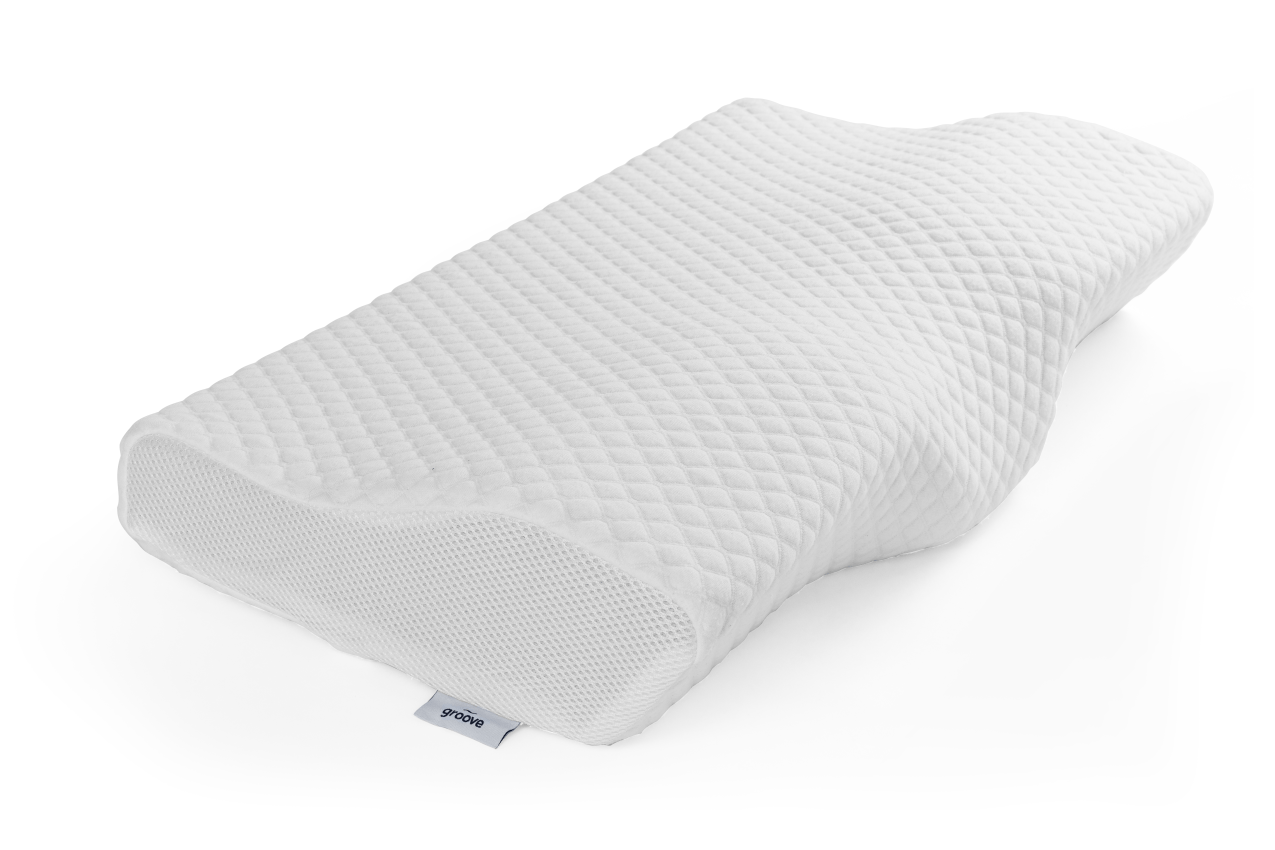
There isn't evidence showing that a particular Groove pillow, or any other branded pillow, treats TMD.
However, if you're looking for a contoured option, the Original Groove Pain Relief Pillow has a memory foam design with a central dip intended to support the head and neck.
For someone whose jaw discomfort is aggravated by direct facial pressure or an uncomfortable neck position, a contoured design may feel more comfortable.
The important consideration is how your individual symptoms respond. Stop using or adjust any pillow setup that consistently increases jaw pain, neck discomfort or headaches.
Discover how to use a memory foam pillow today.
What is the Best Pillow Position for TMJ?
There's no single pillow position proven to improve TMD, but your pillow should allow your head and neck to rest comfortably without excessive flexion, extension or rotation.
If you sleep on your back, position your head comfortably on the pillow without unnecessarily stacking additional pillows underneath. Some people find this reduces direct pressure against the jaw.
If you sleep on your side, choose sufficient pillow height to support your head comfortably and try to avoid pressing a particularly painful side of your jaw firmly into the pillow.
Similarly, if you're using a memory foam pillow, allow the pillow to support your head and neck without forcing either into an awkward angle.
Some memory foam pillows have a dip in the middle. A contoured design may feel comfortable when it supports your head and neck without forcing them into an unnatural position.
Before using one, learn how to sleep on a memory foam pillow to find a comfortable setup.

When to Seek Professional Advice
Speak to a dentist, doctor or appropriately trained clinician if jaw pain persists, repeatedly returns, interferes with eating or sleeping, or occurs alongside reduced jaw movement, painful clicking, recurrent locking, tooth damage or suspected grinding.
Seek urgent medical or dental care for:
- Facial or dental swelling with fever
- Severe tooth pain
- Inability to open or close your mouth
- Inability to eat or drink
- Significant recent facial trauma
- New facial weakness or numbness
- Severe or rapidly worsening pain
Jaw pain can have causes other than TMD, including dental problems, salivary-gland conditions, sinus or ear problems, nerve pain, arthritis and trauma.
Jaw discomfort accompanied by chest pressure, shortness of breath, sweating, nausea or pain spreading into the arm, back or neck may represent a cardiac emergency and requires immediate medical attention.
Conclusion
TMD can be frustrating, particularly when jaw or facial discomfort interferes with sleep.
There's no clinically established best sleeping position or pillow for TMD. However, avoiding sustained pressure on a painful jaw and finding a comfortable head-and-neck position may help some people manage morning discomfort.
A pillow adjustment is one option to experiment with, but it isn't a treatment or cure for TMD.
The Original Groove Pain Relief Pillow has a contoured memory foam design intended to provide head and neck support. Whether this feels comfortable will depend on your anatomy, sleeping position and individual symptoms.
You can also explore our full range of memory foam pillows.
References
- National Institute of Dental and Craniofacial Research: Temporomandibular Disorders
- NIDCR: Summary of TMD Treatments
- BMJ: Management of Chronic Pain Associated With Temporomandibular Disorders
- American Family Physician: Temporomandibular Disorders — Rapid Evidence Review
- NHS: Temporomandibular Disorder (TMD)
About The Author
Myrlène Fortin is a trained Myofunctional Therapist and certified Massage Therapist, Kinesitherapist, and Orthotherapist with a focus on jaw pain, TMJ disorder, teeth clenching, orofacial muscle imbalances, tongue ties, and airway-focused care.