Joint hypermobility means some or all of your joints have a greater range of movement than usual. While not everyone experiences problems with this condition, some people may notice neck pain, stiffness, muscle fatigue or discomfort.
If you're experiencing hypermobility neck pain sleeping, spending hours with your neck in an uncomfortable or extreme position may aggravate symptoms.
That's where pillow height and hypermobility sleeping positions are worth considering.
What Is The Best Pillow For A Hypermobile Neck?
The best neck pillow for hypermobility should prioritise comfortable support rather than forcing your neck into a particular position. No pillow should cause stiffness or pain.
Some sleepers prefer contoured memory foam because it provides consistent support around the head and neck. However, height is just as important as softness or firmness when it comes to hypermobility.
Recent studies and systematic reviews of experiences from 555 patients have concluded that pillow shape and height can affect cervical alignment (Pang, Tsang and Fu, 2021). So, your pillow should comfortably support your head without pushing your neck excessively forwards, backwards or sideways.
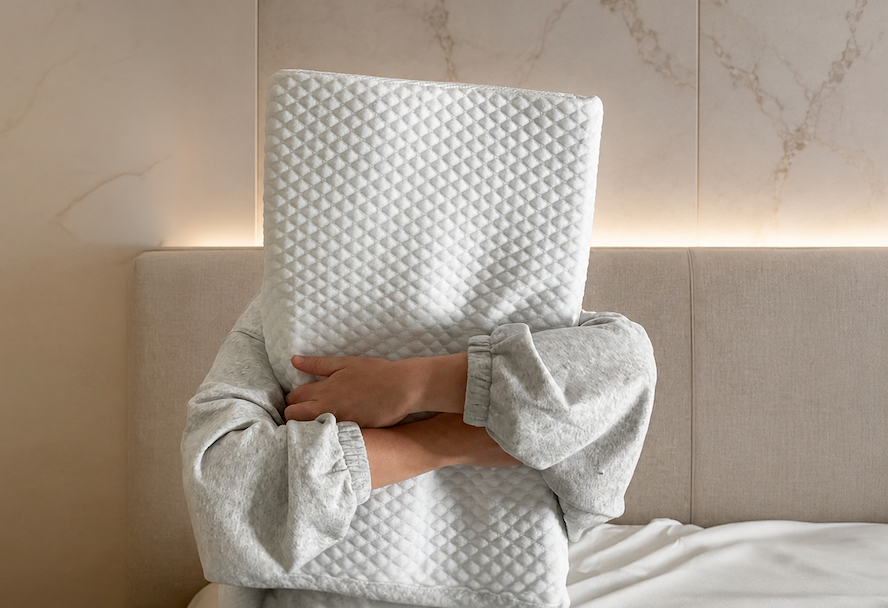
The Groove Adjustable Pillow combines memory foam with four adjustable layers, allowing you to experiment with different heights rather than being restricted to one fixed height.
How to Sleep With a Hypermobile Neck
There's no single answer to how to sleep with a hypermobile neck. Instead, to find a comfortable nighttime posture, you must consider how well your pillow supports your preferred sleeping position.

If You Sleep on Your Back
If you’re a back sleeper, a pillow that's too high can push your head forwards, while one that's too low may feel uncomfortable.
Research has shown that pillow height can affect cervical spine alignment, including the natural curve of the neck, known as cervical lordosis (Ren et al., 2016). With this in mind, it’s best to aim for a height that supports your head without forcing your neck into an exaggerated position.
Back sleepers who prefer a lower loft can remove a layer from the Groove Adjustable Pillow to achieve a thinner set-up.
If You Sleep on Your Side
Side sleepers need a pillow tall enough to fill the space between their head and mattress for proper support.
The right height depends on factors including shoulder width, body shape and how much your mattress compresses. One small 2024 study found that shoulder-related body measurements were linked to the pillow height needed to maintain alignment when side sleeping (Tian et al., 2024).
An adjustable pillow lets you experiment with different heights rather than relying on one supposedly perfect loft, which can be particularly useful if standard, fixed-height pillows don't feel quite right.
Why Adjustable Can Be Better Than Chasing the "Perfect" Cervical Pillow
A highly structured pillow may sound appealing, but fixed contours won't necessarily suit everyone's anatomy or symptoms.
That’s why trying different options is key to finding a match, and adjustability lets you make small changes and assess what actually feels comfortable without buying multiple pillows.
Remember, more support or stiffer designs aren't automatically better. Your pillow shouldn't force your neck into a particular posture or leave you experiencing increased pain, headaches, numbness or other symptoms.
Sleep Positions and Habits That May Aggravate a Hypermobile Neck
Pay attention to habits that leave your neck in uncomfortable positions for prolonged periods.
While this can differ between people, you may want to try to avoid:
- Heavily rotating your neck overnight
- Using an excessively high pillow
- Going without support if uncomfortable
- Stacking several pillows
- Sleeping with an arm under your head
- Forcing a supposedly "perfect" posture
- Frequently stretching an irritated neck excessively
An expert tip: Stomach sleeping requires you to keep your neck rotated for long periods, which may be uncomfortable if you have a hypermobile or irritated neck. If you notice that this position aggravates your symptoms, try sleeping on your back or side instead.

How to Adjust Your Pillow for a Hypermobile Neck
To adjust your pillow for a hypermobile neck, start at a comfortable middle height and make small adjustments rather than big changes. This way, you can see what feels better and focus on finding the right setup for your body.
General advice suggests that back sleepers should remove a layer if their head is noticeably pushed forwards. Side sleepers may benefit from adding height if their head drops significantly towards the mattress.
No matter your position, give each adjustment a reasonable chance before changing it again.
And lastly, stop using a setup if it consistently increases pain or neurological symptoms.
When Hypermobility Needs Medical Advice
Persistent neck pain shouldn't automatically be assumed to be due to hypermobility.
If you have neck pain, seek medical advice for worsening symptoms, especially persistent numbness or tingling, weakness, balance or walking problems, changes in hand coordination, severe or unusual headaches, or symptoms after significant neck trauma.
Pillows can support comfort and positioning, but they cannot treat cervical instability or neurological conditions. Medical professionals are needed in this case.
Last Thoughts
Finding comfortable support for a hypermobile neck may take some experimentation, particularly when everyone's body shape and preferred sleeping position differ. However, you may find better rest with proper sleep aides.
Explore the Groove Adjustable Pillow to adjust your pillow height and create a sleep setup that feels right for you.
References
- Pang, J.C.Y., Tsang, S.M.H. and Fu, A.C.L. (2021). The effects of pillow designs on neck pain, waking symptoms, neck disability, sleep quality and spinal alignment in adults: A systematic review and meta-analysis. Clinical Biomechanics, 85, p.105353. doi:10.1016/j.clinbiomech.2021.105353.
- Ren, S., Wong, D.W.-C., Yang, H., Zhou, Y., Lin, J. and Zhang, M. (2016). Effect of pillow height on the biomechanics of the head-neck complex: investigation of the cranio-cervical pressure and cervical spine alignment. PeerJ, 4, p.e2397. doi:10.7717/peerj.2397.
- Tian, S., Yao, C., Wang, Y., Cao, X., Sun, Y., Wang, L. and Fan, Y. (2024). The individualized optimal pillow height and neck support design for side sleepers. Medical & Biological Engineering & Computing. doi:10.1007/s11517-024-03204-x.