


Finding a comfortable sleep position with hypermobility can be tough, and many people struggle with joint discomfort at night.
However, the right pillows and body support can protect joints, reduce stiffness, and improve sleep quality.
In this article, we explore the best sleep positions for hypermobility and how to set up your pillows for maximum support.
Why Sleep Is Difficult with Hypermobility
Hypermobile joints are more prone to drifting into unsupported positions overnight, which can worsen pain and stiffness by morning.
Studies have shown that 65% of those with hypermobility (specifically EDS) sleep less than 8 hours per night and 26% sleep less than 6 hours per night (Crews-Stowe et al., 2025). Many subjects stated that pain was the cause of their poor sleep schedule.
Common issues when sleeping with hypermobility include:
- Hyperextension during sleep – Joints can bend beyond their safe range if you move around at night.
- Collapsing joints – This is particularly common in the neck, shoulders, and hips.
- Poor spinal alignment – Which can lead to discomfort across the back, shoulders, hips, and pelvis throughout the night and morning.
Sleeping with unsupportive pillows allows the head, shoulders, and hips to sink or rotate while you sleep, leaving ligaments overstretched. This explains why many people with hypermobility feel stiffer or sore when they wake.
Best Sleep Positions for Hypermobility
How you sleep makes a huge impact on the rest you get. Choosing the proper hypermobility sleep position can help protect joints and reduce pain.
Here are the recommended sleeping positions for those with hypermobility.
1. Side Sleeping with Full-Body Support (Often Best)
For many people, hypermobility side sleeping provides excellent alignment and comfort throughout the night.
In this position, the nose stays in line with the sternum, the spine remains neutral, and the hips are stacked. These factors are important as they keep you in a healthy position without any hyperextension or excess strain.
Pillow setup for side sleeping support:
- Head: Use a cervical pillow to keep the neck neutral. The Groove Adjustable Pillow is ideal for personalised height and contour support.
- Between knees: Place a pillow to prevent hip rotation. A Combination Pillow works well for this.
- Front support: Hug a body pillow to stop the top shoulder collapsing forward. The Groove Body Pillow provides long, full-body support.
- Waist/back: Add a small bolster under the waist or a pillow behind the back for extra stability.
This setup can reduce strain on joints and is often recommended as the best sleep position for hypermobility.
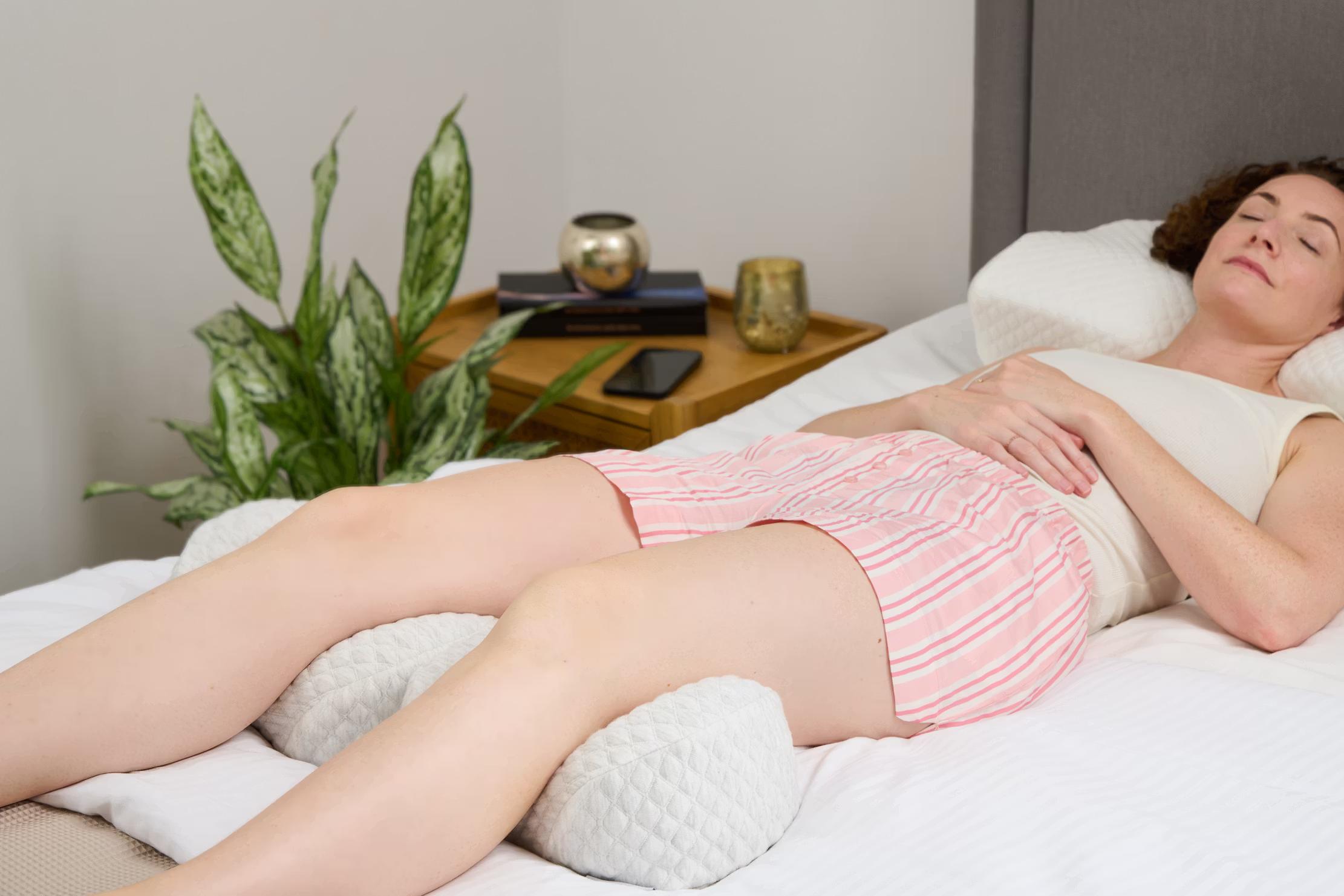
2. Back Sleeping with Joint Support
Back sleeping is another go-to, as it helps maintain natural spinal curves while keeping the chin neutral.
However, proper hypermobility back sleeping support and position is needed to prevent the neck and spine from drifting into uncomfortable angles.
Pillow setup for back sleeping support:
- Under knees: Pillows to slightly elevate the knees reduce lumbar strain. A Combination Pillow is ideal here.
- Lower back: A small folded towel or cushion supports the lumbar curve.
- Sacrum (buttocks and lower back): Optional triangular or small pillow if lying flat causes discomfort.
Buy Groove® Pillow for Knee & Hip Pain
3. Quarter Sidelying (Stability-Focused Option)
Quarter sidelying is a hybrid position for people who cannot tolerate full side or back sleeping.
To achieve this EDS sleep position, lean slightly back onto a bolster or body pillow with the bottom leg extended and the top leg supported.
This position helps maintain partial spinal support while preventing overstretching of the shoulder and hip joints. You can also use small pillows or bolsters alongside it for extra stability.
Extra Tips for Better Sleep with Hypermobility
For better hypermobility joint support sleep, small adjustments and supportive tools can make a big difference each night.
- Use body or maternity-style pillows for full-body support
- Avoid positions that feel comfortable at first but overstretch joints
- Gentle mobility work under professional guidance can help maintain the range of motion
- Maintain a consistent sleep routine to reduce muscle guarding and improve rest
Try out with different at-home tips in addition to different sleeping patterns and the best pillows for hypermobility and keep what feels comfortable.
It’s also suggested that you keep good sleep hygiene, such as excersiginf in the day and not using technology in your bed to encourage restful sleep (The Ehlers Danlos Society, n.d.)
If something doesn't feel good, don’t force it into your sleep routine. A medical professional should address any prolonged pain or new symptoms.
Last Thought
Everyone’s joints and comfort levels are different, so experimentation is key. Whether you prefer side, back, or quarter sidelying positions, a combination of adjustable and supportive pillows can make a noticeable difference in your comfort and sleep quality.
If you’re ready to try better sleep support, it might be worth looking at memory foam pillows designed to adapt to changing sleep needs, like those from Groove.
References
- Crews-Stowe, C., Tudini, F., Jung, M.-K., Forman, J., Riley, B., Eton, S. and Levine, D. (2025). Sleep Characteristics in Individuals with Ehlers-Danlos Syndrome. Medical Sciences, 13(3), pp.85–85. doi:https://doi.org/10.3390/medsci13030085.
- The Ehlers Danlos Society. (n.d.). Sleep problems in EDS and HSD. [online] Available at: https://www.ehlers-danlos.com/sleep/.